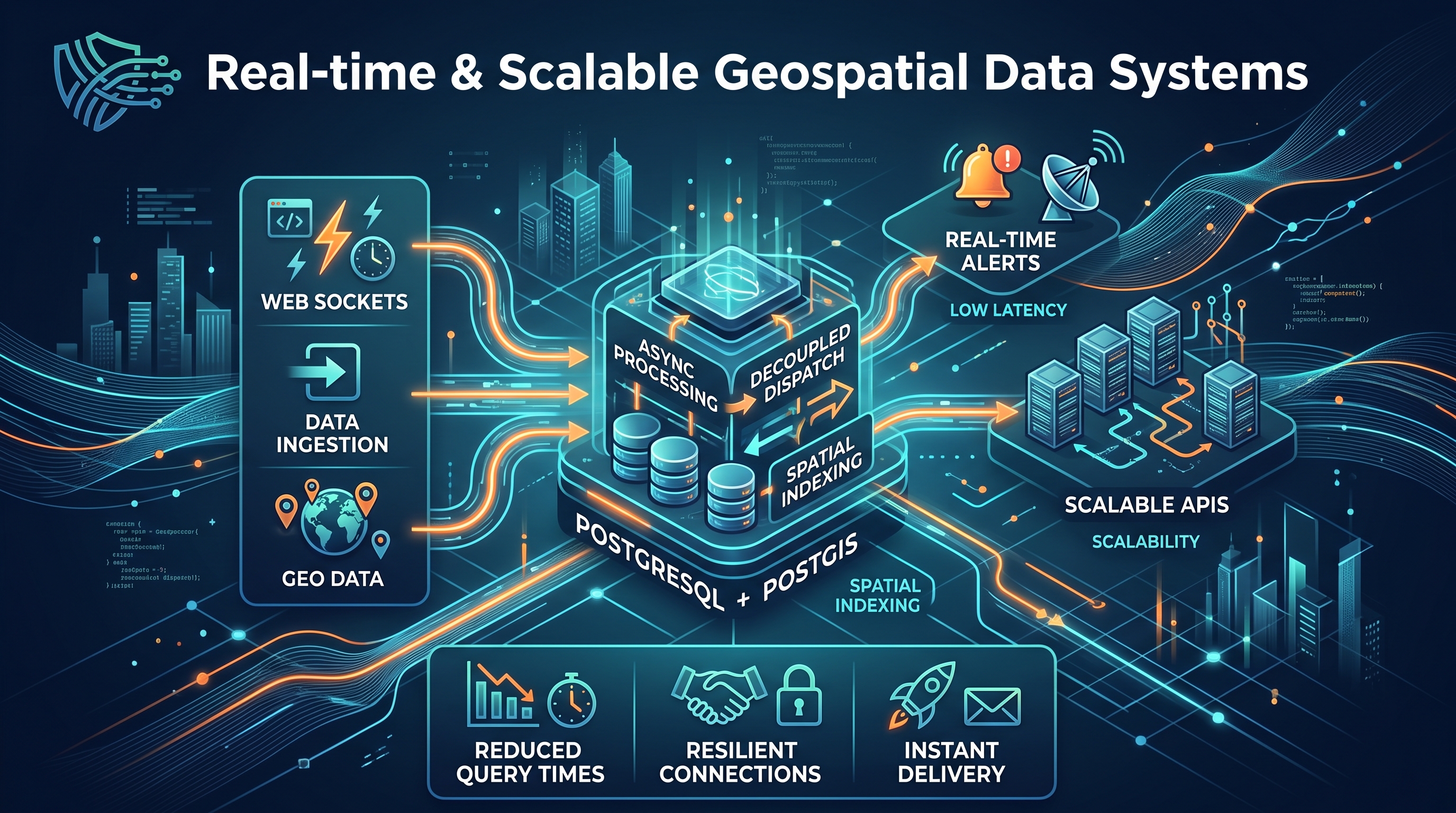
A sleek user interface with fluid animations is often what catches the user's eye first. However, when building real-time monitoring and geospatial alerting platforms, the true engineering challenge lies beneath the surface: managing continuous data streams without suffocating the database or degrading system throughput.
1. Spatial Indexing: The PostGIS Advantage
In geospatial architectures, querying whether an incident or alert falls within a client's radius using standard comparison operators causes catastrophic query degradation under load:
-- Inefficient query without spatial indexing
SELECT * FROM incidents
WHERE latitude BETWEEN 35.0 AND 36.5
  AND longitude BETWEEN 5.0 AND 6.5;
Switching to PostgreSQL with PostGIS and utilizing native geometry/geography types paired with a GiST (Generalized Search Tree) index transforms lookup performance:
-- Efficient bounding spatial query using PostGIS
SELECT id, title, location
FROM incidents
WHERE ST_DWithin(
    location,
    ST_SetSRID(ST_MakePoint(6.17, 35.55), 4326)::geography,
    50000 -- 50km radius
);- GiST Indexes: Allow the database to use bounding box trees, reducing candidate rows before exact distance math is performed.
- Sub-second Response: Drops execution times from multiple seconds on large datasets to single-digit milliseconds.
2. Real-Time Streaming: Sockets Over Polling
Repeated polling from mobile and web clients drains battery life and floods endpoints with unnecessary HTTP handshake overhead. Implementing a managed WebSocket layer (e.g., using Socket.io) offers:
- Event-Driven Updates: Pushing updates only when fresh telemetry or critical alerts are processed.
- Heartbeats & Reconnection: Robust reconnection logic to gracefully handle intermittent network disconnects in the field.
- Room Subscriptions: Isolating broadcasts so clients only receive events relevant to their active viewport or administrative zone.
3. Decoupling Data Ingestion from Dispatch
External data synchronization—such as periodic telemetry fetching, thermal satellite anomalies, or external sensor feeds—should never run synchronously on your primary API loop.
By decoupling the architecture:
- Ingestion Worker: Collects raw records, normalizes payloads, and runs spatial intersection checks against watchlists.
- Database Layer: Inserts or updates deduplicated records with indexed coordinates.
- Dispatch Worker: Emits lightweight payloads via WebSockets to connected dashboards and fires background push notifications via FCM (Firebase Cloud Messaging) asynchronously.
Conclusion
A reliable architecture isn't just about handling sunny-day scenarios; it is defined by how resilient it remains during peak load and unstable network conditions. Investing in proper indexing, asynchronous dispatching, and persistent bidirectional communication ensures your real-time system stays robust when seconds count.