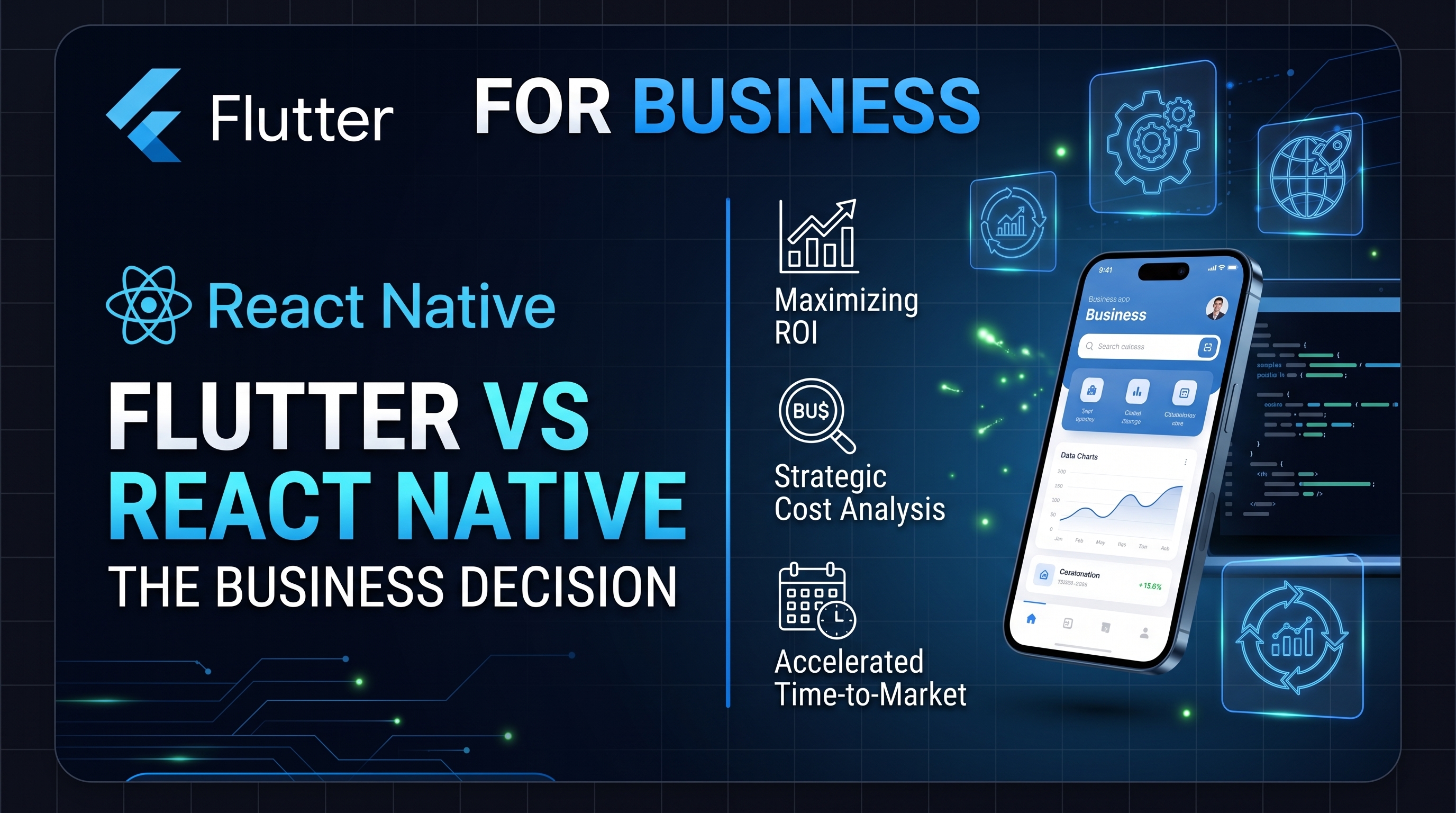
Flutter vs React Native for Business: Which Framework Should You Choose?
For startups and established enterprises alike, cross-platform mobile app development represents an effective strategy to reach both iOS and Android users while cutting development costs and accelerating time-to-market. The two dominant market leaders—Flutter (backed by Google) and React Native (backed by Meta)—both allow a single codebase approach, but each carries distinct technical and business trade-offs.
1. Performance and User Interface
How an app renders its interface directly impacts user retention and brand perception:
- Flutter: Uses its own high-performance rendering engine (Impeller/Skia) to draw every pixel directly on the canvas. This guarantees pixel-perfect consistency across all devices and smooth 60–120 FPS animations without relying on native platform bridges.
- React Native: Relies on a bridge (or the modern JSI architecture) to communicate with native iOS and Android UI components. While it delivers an authentic native look and feel, high-load computations or complex animations can introduce minor performance bottlenecks.
2. Development Cost and Talent Availability
Building and scaling your technical team depends on market availability and existing infrastructure:
- React Native (JavaScript / TypeScript): Benefits from the massive global JavaScript developer ecosystem. If your business already has a React-based web team, onboarding them to mobile development requires minimal training and lower recruitment overhead.
- Flutter (Dart): While Dart is straightforward for Object-Oriented programmers to learn, the pool of senior Flutter developers is relatively smaller compared to JavaScript, which can slightly affect specialized hiring speed depending on your region.
3. Time-to-Market and MVP Readiness
When validating product-market fit, speed is critical:
- Flutter: Accelerates MVP deployment via rich, customizable pre-built widgets and features like
Hot Reload, allowing rapid iteration on custom-branded applications. - React Native: Enables heavy code sharing between web and mobile interfaces through shared TypeScript business logic, ideal for companies launching synchronized web and mobile products simultaneously.
Comparison Matrix for Decision-Makers
| Decision Criteria | Flutter | React Native |
|---|---|---|
| Primary Language | Dart | JavaScript / TypeScript |
| Rendering Model | Proprietary Canvas Rendering | Native UI Wrappers |
| UI Consistency | 100% Identical on all OS | Native Look & Feel per OS |
| Code Reusability (Web) | Moderate (Flutter Web) | High (React / React Native Web) |
| Hiring Pool Size | Growing rapidly | Massive (JavaScript ecosystem) |
Final Business Verdict
Choose Flutter if: Your application demands custom branding, heavy animations, real-time graphic fidelity, or an exact uniform interface across all platforms.
Choose React Native if: Your company already possesses strong JavaScript/React engineering talent, requires heavy code sharing with an existing web application, or prioritizes out-of-the-box native platform design conventions.