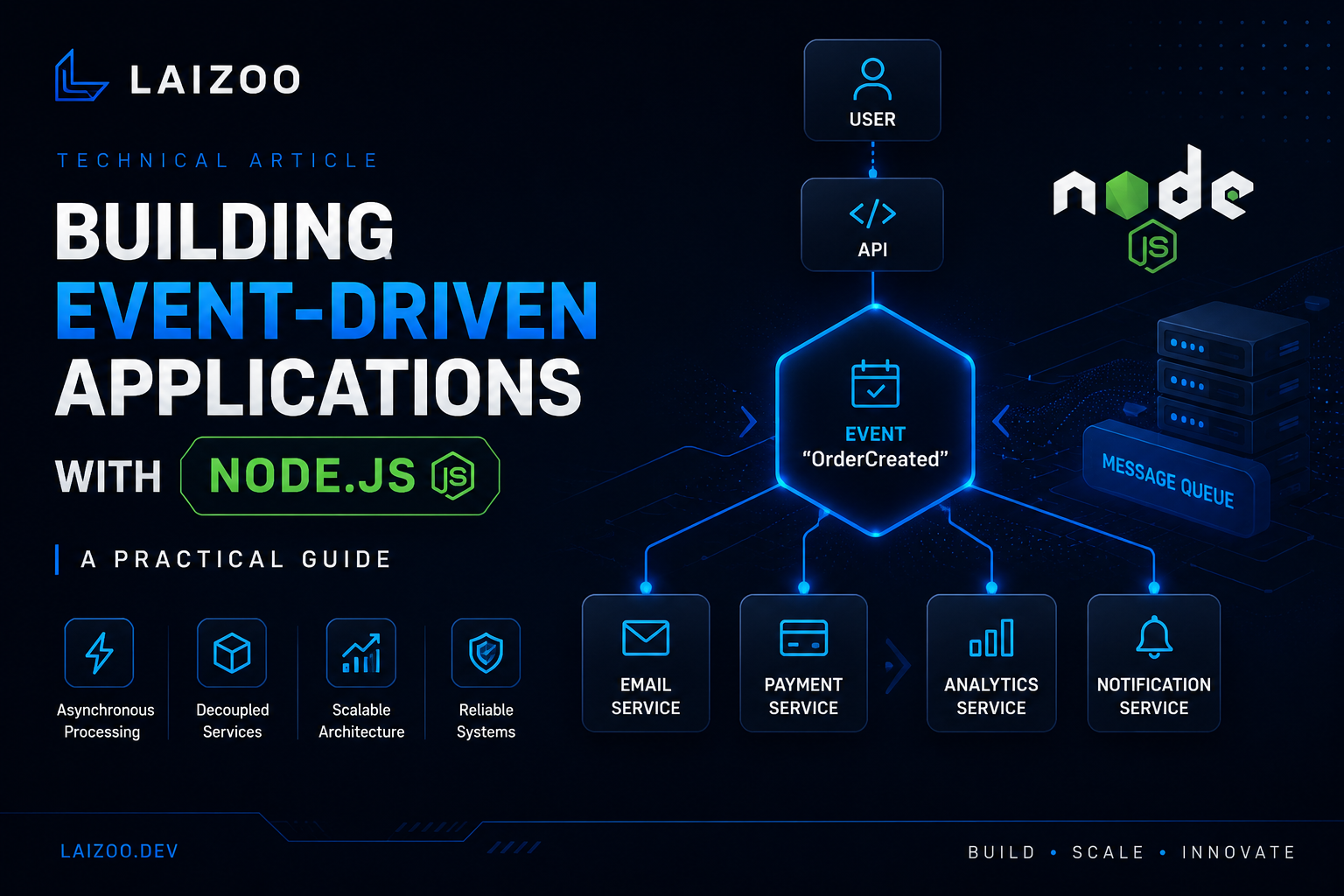
Building Event-Driven Applications with Node.js
Modern applications are expected to handle more users, more data, and more interactions without becoming slow or difficult to maintain.
One architectural approach that can help developers build scalable systems is Event-Driven Architecture (EDA).
Instead of making every component directly depend on another component, services can communicate through events.
For developers working with Node.js, this approach can be especially useful because Node.js is designed around asynchronous and event-driven programming.
What Is Event-Driven Architecture?
In a traditional application, one component often calls another directly.
For example:
User → API → Database → Email Service
The API may need to wait for the email service before completing the request.
With an event-driven architecture, the flow can be different:
User → API
        ↓
   "OrderCreated"
        ↓
 ┌──────┼────────┐
 ↓      ↓        ↓
Email  Payment  Analytics
The application publishes an event such as:
OrderCreated
Other components can listen for that event and perform their own tasks.
The original service does not necessarily need to know how every consumer works.
Why Use Event-Driven Architecture?
1. Better Separation of Responsibilities
Each component can focus on a specific responsibility.
For example:
Order Service → creates orders
Payment Service → processes payments
Notification Service → sends notifications
Analytics Service → records business events
This makes the system easier to maintain as it grows.
2. Asynchronous Processing
Some operations do not need to happen before the user receives a response.
For example, after a user creates an account, the application could immediately return:
Account created successfully.
Then an event can trigger:
- Welcome email
- Analytics tracking
- Notification
- Background processing
This can improve the user experience.
3. Easier Scaling
If the notification system becomes overloaded, you can scale notification consumers independently without scaling the entire application.
This is one of the major advantages of event-driven systems.
Events, Producers, and Consumers
There are three important concepts to understand.
Producer
A producer creates or publishes an event.
eventBus.emit("user.created", {
    userId: user.id,
    email: user.email
});
Event
An event represents something that happened.
Examples:
user.created
order.created
payment.completed
file.uploaded
subscription.cancelled
Events should describe facts rather than commands.
For example:
OrderCreated
is generally better than:
CreateOrder
because the first describes something that already happened.
Consumer
A consumer listens for an event and performs an action.
eventBus.on("user.created", async (user) => {
    await sendWelcomeEmail(user.email);
});
The consumer does not need to be tightly coupled to the code that created the user.
A Simple Node.js Example
Node.js provides an EventEmitter that can be used to understand the basic concept.
const EventEmitter = require("events");

const eventBus = new EventEmitter();

eventBus.on("order.created", (order) => {
    console.log(`Processing order ${order.id}`);
});

eventBus.emit("order.created", {
    id: "ORD-1001",
    total: 149.99
});
This is a simple example, but the same concept can be extended using external message brokers and distributed services.
EventEmitter vs Message Brokers
Node.js EventEmitter is useful for communication inside a single application process.
However, distributed systems often require dedicated messaging infrastructure.
Popular technologies include:
- RabbitMQ
- Apache Kafka
- Amazon SQS
- Redis Streams
The right choice depends on the system's requirements.
For example, Kafka can be useful when you need durable event streams and high-throughput event processing.
RabbitMQ can be a good choice for message-based communication and task distribution.
Important Challenges
Event-driven architecture is powerful, but it also introduces complexity.
Debugging
A single user action may trigger multiple asynchronous processes.
When something fails, developers need good logging and tracing to understand the complete flow.
Event Ordering
Some systems require events to be processed in a specific order.
You need to design carefully around ordering guarantees.
Duplicate Events
A consumer may receive the same event more than once.
For this reason, consumers should often be designed to be idempotent.
For example, processing the same payment event twice should not charge the customer twice.
Error Handling
Events can fail after they have been published.
Reliable systems should consider:
- Retries
- Dead-letter queues
- Monitoring
- Logging
- Failure recovery
When Should You Use It?
Event-driven architecture can be a strong choice when:
- Your application has many independent processes.
- Background jobs are important.
- Different services need to react to the same event.
- You expect the system to scale significantly.
- You want to reduce direct coupling between services.
However, it may be unnecessary for a small CRUD application.
Architecture should solve a real problem, not simply add complexity.
Final Thoughts
Event-driven architecture is not just about using Kafka, RabbitMQ, or another messaging system.
The most important idea is decoupling components through events.
For Node.js developers, understanding this architecture can help when moving from simple applications toward more scalable backend systems.
Start simple.
Understand the event flow first, then introduce more advanced infrastructure when your application actually needs it.
Key Takeaways
- Events represent things that happened.
- Producers publish events.
- Consumers react to events.
- Asynchronous processing can improve scalability and responsiveness.
- Consumers should handle duplicate events safely.
- Message brokers become useful when systems grow.
- Not every application needs event-driven architecture.